Written by Sanjeevan Bisnath, MaxProf Operations HOD
The 2026 national budget takes a practical approach, aiming to grow the economy while keeping government spending under control. More than R1 trillion will be invested in public infrastructure over the next few years, with projects focused on roads, rail, energy, and water. These investments are expected to create jobs and improve everyday services. At the same time, government is tightening rules for municipalities, linking funding to performance, and providing targeted support to improve water, electricity, and sanitation. Tax relief measures, savings incentives, and reforms to global tax rules add to the mix, making this a budget that balances support for households with long‑term financial stability.
Notable Measures
- Public-sector infrastructure expenditure is projected to surpass R1 trillion over the medium term. Key areas of focus comprise road maintenance (SANRAL), passenger rail system restoration (PRASA), expansion of energy transmission, and bulk water projects. These initiatives aim to facilitate job creation, enhance logistics, and foster sustained economic growth.
- A significant proportion of municipalities (63%) are experiencing financial hardships. In response, the government is rolling out reforms that tie funding to actual performance. A total of R27.7 billion has been earmarked to enhance essential metro trading services such as water, electricity, and sanitation. To ensure sustainability, it is mandated that revenue generated from these services be reinvested back into their improvement. Furthermore, municipalities that consistently underperform could forfeit their direct authority over infrastructure grant allocations. These measures are designed to directly impact the reliability of urban water supply, electricity distribution, and waste management services.
- Government has withdrawn previously anticipated tax increases totalling about R20 billion.
- Treasury plans to consider possible fiscal anchor mechanisms with Cabinet during 2026.
- The annual Tax-Free Savings Account contribution limit rises to R46,000.
- Updated global minimum tax rules aimed at limiting profit shifting will be implemented in 2026/27.
- The Targeted and Responsible Savings initiative has identified R12 billion in expenditure reductions.
Fiscal Health

Tax Policy Updates
Individual and Corporate Taxation
- Personal income tax brackets have been fully adjusted for inflation, preventing bracket creep.
- Medical tax credits have been increased in line with inflation.
- Various tax thresholds and savings limits have been raised, offering relief to individuals and small businesses.
- No changes were made to corporate tax, VAT rates, or the sugar tax.
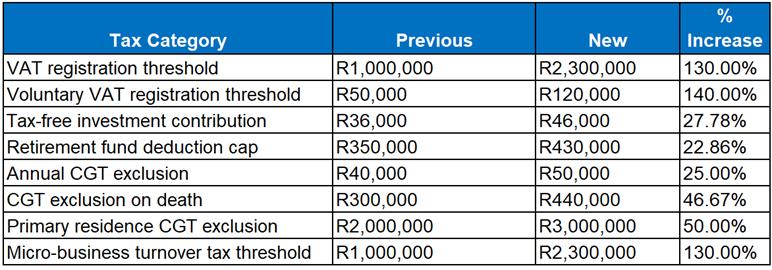
Revised Tax Threshold Adjustments (Effective 1 April 2026)
The following tax limits have been increased to account for inflation and policy adjustments.
The table below compares the previous thresholds with the newly revised amounts.
Key Observations:
- The largest increases relate to structural policy reforms (such as VAT and micro-business thresholds), rather than simple inflation adjustments.
- Capital-gains-related exclusions rose above inflation, particularly for estates and residential property.
- Savings and retirement incentives increased moderately, broadly tracking inflation with modest real relief.
Fuel & Green Levies
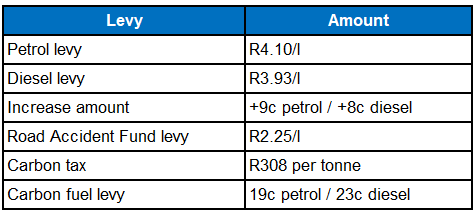
Additional Levies
- Diamond export levy rises by 5%.
State and Public Sector Developments
- Transnet has obtained R16.1 billion to support infrastructure investment.
- Public sector employees are expected to receive an average salary increase of roughly 4.4%.
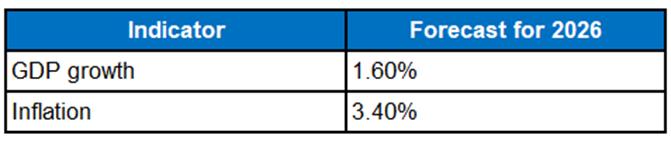
Economic Outlook
Overall Assessment
The 2026 budget reflects a cautiously optimistic and broadly market-friendly fiscal stance. It strikes a balance between supporting economic growth and maintaining fiscal discipline, with infrastructure investment positioned as the central growth engine. The commitment to over R1 trillion in infrastructure spending, alongside targeted funding for struggling municipalities and entities such as Transnet, signals a clear policy priority of improving logistics, energy capacity, and service delivery to unlock private-sector activity.
From a tax perspective, the budget is moderately expansionary for households but neutral for corporates. Inflation adjustments to personal tax brackets and credits provide relief without reducing revenue in real terms, while the decision not to raise VAT or corporate taxes supports investor confidence. The withdrawal of previously proposed tax hikes further reinforces a pro-growth tone.
However, structural risks remain. Municipal financial instability, rising public-sector wage costs, and ongoing pressure to consolidate debt mean execution will be critical. The proposed fiscal anchor framework could strengthen credibility if implemented effectively, but details will matter.
In summary, this is a pragmatic, stability-focused budget that prioritises infrastructure and compliance-based reform over aggressive austerity or stimulus. It is broadly positive for business sentiment and medium-term growth, but its success depends heavily on implementation capacity and fiscal discipline over the next three years.